Tuesday, 21 May 2013

The Chilling Facts About Frozen Yogurt

What’s not to love about soft serve frozen yogurt?  It can be a delightful way to enjoy a frozen dessert and reap some bone-strengthening calcium to boot.  According to the USDA, a half cup of soft serve vanilla frozen yogurt can be enjoyed for only about 115 calories yet also provides 10 percent of the Daily Value (DV) for calcium. 

Unfortunately, if you visit a frozen yogurt shop where you have the liberty to choose the amount of frozen yogurt from a variety of dispensers, you may be portion-size challenged by the humongous size containers available.  (See the photo below of the containers from a local frozen yogurt shop.)


The container on the left in the photo holds 16 ounces while the hefty one on the right holds 32 ounces, both of which dwarf the ½ cup serving size that is pictured in the middle. Even if you only fill either container halfway, your portion size would be about 1 to 2 cups of yogurt, which translates into about 230 to 460 calories. 

These huge containers can be a calorie nightmare as research suggests ice cream bowl sizes can impact how much you eat.  In a study published in the American Journal of Preventive Medicine, 85 adults who were given a large ice cream bowl (34 ounces) served themselves over 30 percent more ice cream than those who used a medium bowl (17 ounces).   It appears from this study that when using a large bowl, individuals unconsciously increase the “appropriate” serving size in relationship to the size of the container.   Since it is estimated that individuals consume about 90 percent of the food that they serve themselves, the bigger the container the more you will likely eat.

Then, there are the toppings, which can also make your frozen dessert top heavy in the calorie department.  Here’s a listing of the calories in a variety of popular toppings:
 
Source: TCBY

If you fill a 16-ounce frozen yogurt container halfway, which will be about a cup of yogurt (230 calories) and decorate it with two candy or cookie toppings and some syrup, your dessert now weighs in over 400 calories. 

So, how can you enjoy frozen yogurt without compromising your waist?  Try these tips:
  1. Pick the smallest container available.
  2. Fill the container at least halfway with sliced berries, chopped manages, or whatever fresh fruit that is available.
  3. Then top it off with the frozen yogurt.  You will be surprised how much less yogurt you will take when the container is already stuffed with fruit. 
  4. Go easy on the toppings.
Doing all of the above tips will help keep your frozen yogurt dessert under about 175 calories (minus the toppings).  PS:  For fun, TCBY (The Country’s Best Yogurt) has an interactive, build your own frozen yogurt sundae on their website, which will give you the calorie content of your favorite flavor and toppings.  Click here to start building.

                                         Follow Joan on Twitter at:  joansalgeblake

Thursday, 16 May 2013

Study: An Eating Out Trick to Help You Order Less

Source: NEJM
If you grab your breakfast from a drive-thru, order lunch at a local sandwich shop, and/or dine out for dinner on a regular basis, please read on. 

New research suggests that Americans are consuming approximately 35 percent of their daily calories chowing down at these types of eateries.  With Americans’ love of eating out and restaurant portions expanding, along with our waistlines, the Affordable Care Act has required that chain food establishments with 20 or more locations begin disclosing nutrition information for their standard menu items.   Research has shown that providing consumers with calorie information upfront can alter their menu choices and aid them in ordering lower calorie options.  But is there an even more effective way to change eating habits?

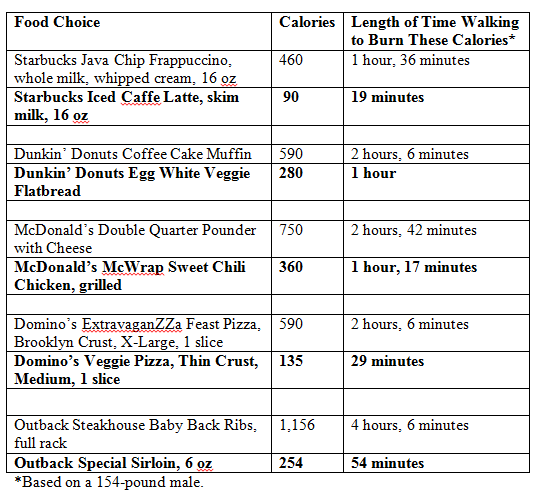
In a recent editorial in the New England Journal of Medicine, researchers at Johns Hopkins Bloomberg School of Public Health have proposed not only displaying calories on the menu but also posting the physical-activity equivalents that would be needed to burn off the amount of calories in the food item.  (See above illustration.)  Research supports this clever idea.  In a study of over 800 individuals that was published in the journal, Appetite, researchers uncovered that showing folks a menu with both the calories and the number of miles they needed to walk in order to burn those calories was more effective in influencing lower calorie meal selections than just showing the calories alone.

To get an idea of what this would look like, here are some selections from local eateries.  The BOLD items are leaner choices.

Would displaying the calories along with the physical-activity equivalents influence your food choices more than just viewing the calories?  Please post your thoughts below. 


                                   Follow Joan on Twitter at:  joansalgeblake

Thursday, 9 May 2013

What You Need to Know about Gov Chris Christie’s Weight Loss Surgery

Source:  National Institutes of Health
Governor Chris Christie of New Jersey made a very personal decision this year to undergo weight loss surgery to help him win the battle with the bathroom scale.  His choice of weight loss strategy could prove to be effective as, according to research, patients can expect to lose from about 30 to over 85 percent of their excess body weight, depending upon the type of surgery performed.

In the Governor’s situation, he chose a procedure that involves using an adjustable band that is surgically inserted and wrapped around the juncture of the esophagus and stomach.  Once inserted, the band is tightened creating a smaller stomach pouch at the entrance of the full-size stomach (see illustration).  The smaller pouch can hold about 1 cup of food whereas the stomach typically holds 4 cups.  When a person eats, this petite pouch fills up fairly quickly causing a feeling of immediate fullness so that the individual stops eating. 

With fewer calories entering the stomach and ultimately the digestive system, weight loss occurs in the body.  According to Kellene Isom, a registered dietitian and Bariatric Program Manager at Brigham and Women’s Hospital in Boston, a person who was typically consuming 3,000 to 4,000 calories daily prior to the procedure will be restricted to 1,200 calories a day once the surgery is done.

While weight loss surgery may sound like an intriguing solution to shed pounds, there are some nutritional and lifestyle issues to consider.  Ironically, many obese individuals are actually malnourished prior to the procedure as their diets tend to be high in calorie-rich foods (sweetened beverages and desserts) but low in vitamins and minerals.   This puts them at risk for further nutritional deficiencies after the procedure when their calories are so drastically reduced it is impossible to meet one daily needs.   In particular, obese individuals are at a higher risk for vitamin D deficiency due to not only a poor diet but also because this fat soluble vitamin gets buried in the body’s fat stores so it is not readily accessible to be utilized by the body.  In other words, the vitamin is in the body but can’t be activated and utilized so vitamin D blood levels are low.

After the procedure, your diet will be forever altered.  Isom’s patients are instructed not to drink liquids with meals to avoid stretching the pouch.  They must give up caffeine as it can be dehydrating and an irritant to the stomach, and they must also forgo carbonated beverages as it often causes discomfort.  A multivitamin and mineral supplement must be continued indefinitely to ensure that deficiencies don’t occur years after the procedure.

Lastly, the weight loss isn’t necessarily permanent.  “Patients typically gain back about 10 to 15 percent of the weight loss," claims Isom.  “However, the procedure can be helpful for some people.  It can help individuals develop  a reconnection with their body as to when they are truly hungry, and even more importantly, when they are full in order to better manage their weight.” 


                                              Follow Joan on Twitter at: joansalgeblake
Wednesday, 8 May 2013

The Swiss Army Knife of Essential Oils ~ Lavender


Lavender has often been called the "Swiss Army Knife" of essential oils due to it is such a versatile oil. It is a universal oil with many applications.  If your budget only allows you to buy one essential oil, then I recommend to purchase lavender. 

Place of origin
Lavender is grown around the Mediterranean area. France is one of the major areas where it is cultivated, but lavender is also cultivated in Spain and England.

Historical uses
The medicinal and perfume properties of lavender has been used for a very long time. The Romans used lavender for their baths and it was used to ward off evil spirits in the Middle Ages. Lavender derives from the Latin word lavare, which means to wash.

Constituents
The higher altitude lavender grows on, the higher the ester content will be. The esters are soothing, antimicrobial and balancing. Lavender also has linalool ociemene, 1,8 cineole, octanone, camphor, caryopyllene, terpinene-4-ol.

Characteristics
Lavender is colorless or sometimes yellow to green oil with aromatic herbaceous and slightly floral scent.

Fragrance
The aroma is very calming and soothing to the mind. It is relaxing and balancing, both emotionally and physically. The top note is fresh, sweet, strong and herbal-floral aroma. The middle note is pleasant, clean with a sweet floral herbaceous scent with a woody undertone. The base not is perfumery. It is soothing, refreshing, slight herbal-floral. 


Indications:

Mind and Spirit
Lavender is a sedative nervine and as such it has historically been a helpful oil for psychological and nervous disorders. Some conditions that have historically benefitted from the use of lavender are insomnia, hysteria, depression, migraine.  Lavender is also an analgesic agent, and its sedative and analgesic properties are said to help migraine and headaches. Lavender is also said to alleviate stress and may also be helpful in fearful situations.

Body:
Lavender is a very versatile oil and is a definite choice for the first aid kit. It is antiseptic and it has historically been helpful in flu, wounds, catarrh, cystitis, colds and coughs. It also possesses antispasmodic actions and it has traditionally been used to alleviate asthma and bronchitis.  Its antispasmodic, analgesic, and relaxant actions has historically provided relief in muscular pain and rheumatism.

Lavender has also historically been used to lower blood pressure and according to Battaglia, also acts as a stimulating agent for someone with a weak heart. He also says it has emmenagogue actions and is therefore beneficial for scanty periods. Battaglia says lavender has low toxicity levels and is therefore a good oil for treating different childhood cuts, scratches, and infections.

I also learned that lavender has antihistamine properties and many have used lavender for allergies with great results. Learn more about essential oils and allergies:
Essential Oils & Allergies


Skin and hair:
Lavender has become the most useful oil when treating burns and it is even used by European hospitals. It has excellent healing properties on the skin. According to Battaglia, its analgesic and antiseptic properties will ease the pain and prevent infection of the burn. Its cytophylactic actions promotes rapid healing and reduce scarring. Lavender's anti-inflammatory and soothing properties and according to Battaglia is said to treat dermatitis, psoriasis, eczema, acne, and boils.

Actions
Analgesic, antibacterial, antidepressant, antimicrobial, antirheumatic, antiseptic, antispasmodic, aromatic, bactericidal, carminative, cholagogue, diuretic, emmenagogue, hypotensive, insecticide, nervine, sedative, stimulant, stomachic, vulnerary.

According to Gary Young, lavender is also antitumoral, and anticonvulsant.

Contraindications
There are no known contraindications to lavender. Consult your physician if you're pregnant or under  a doctor's care. Lavender is safe for use on small children.


Possible skin sensitivity. If pregnant or under a doctor's care, consult your physician. Dilution not required; suitable for all but the most sensitive skin. Generally safe for children over 2 years of age."


Before you leave:


I recommend that you always perform a skin patch test when you try a new oil.


Check out my safety page to make sure you are aware of any contrindications before you use essential oils. Some oils are not suitable when suffering from certain conditions. AlsoRead this Before You Start Using Essential oils. Some oils should not be applied prior to sun exposure so make sure you check this list before spending time in the sun.

Not sure how to apply the oils? Visit these pages to learn how to apply the oils:
If you're new to essential oils you might want to check out my Getting Started Guide. 

--------------------------------------------------------------------------------------------------------

Johanna is an aromatherapist and she is passionate about educating people about health, essential oils, real food, natural remedies, and nutrition so they make healthier choices in their lives. 
Follow Johanna on twitter and facebook for more health tips and information.


Photo Credit


Sources:


Gary Young, ND (2006). Essential Oils, Integrative Medical Guide. Essential Science Publishing
Salvatore Battaglia (1995). The Complete Guide to Aromatherapy. The Perfect Potion Pty Ltd

Tuesday, 7 May 2013

Sipping Tea for a Healthy Heart

Photo Source:  Lipton
I was lucky enough to receive the entire three seasons DVD collection of Downton Abbey as gift from a friend.  After being totally immersed and hooked after the first DVD, I found myself habitually watching the remaining eight DVDs mimicking the English characters continually sipping on a soothing pot of tea.  I have to thank the writers of the series for this new tea drinking habit, which I have since uncovered has the power to fight against heart disease.

Both black and green teas contain certain flavonoids called catechins, which are phytochemicals that have been shown to help maintain healthy blood vessels.   According to Baiz Frei, PhD, a researcher at Oregon State University, the catechins appear to work their magic by increasing the nitric oxide production in the blood vessels.  Nitric oxide is a substance in the body that can increase the dilation or relaxing of the blood vessels and inhibit the clumping of platelets that are part of artery-clogging plaque as well as the formation of blood clots.  The combination of the constriction of the blood vessels, the buildup and rupture of the plaque, and the presence of a blood clot are the causes of most heart attacks and strokes, according to Frei. 

While tea is the major source of flavonoids in the diets of Americans, the longer you steep the tea, the more flavonoids in your brew.  With the warmer weather approaching, a tall glass of iced tea can be a cooler way, rather than hot tea, to get these flavonoids, according to Frei.  (But go easy on the added sugar.) 

So how much tea do you need to sip daily to reap some of these heart health benefits?  The exact amount is not known but a review of over 15 studies found that the incidence of a heart attack among individuals was reduced by 11 percent in those consuming at least 3 cups of hot tea daily.

While Downton Abbey fans may have to wait until January 2014 for the next season to start, brewing up a pot of tea daily may not only help you stay emotionally connected with the series but may also help soothe your heart.
Follow Joan on Twitter at:  joansalgeblake

Thursday, 2 May 2013

Ocotea ~ Ocotea quixos


Ocotea is distilled from a tree found in the Amazons, on the west side of the Andes Mountains. It belongs to the botanical family Lauraceae. The locals in Equador call it false canilla, or false cinnamon. The trees can grow up to 60 feet tall and 48 inches in diameter. Its historical use dates back 500 years and it was used to aromatize cakes and sweets. Ocotea has also historically been used as an disinfectant and for digestive support.


Before you leave:


I recommend that you always perform a skin patch test when you try a new oil.


Check out my safety page to make sure you are aware of any contrindications before you use essential oils. Some oils are not suitable when suffering from certain conditions. AlsoRead this Before You Start Using Essential oils. Some oils should not be applied prior to sun exposure so make sure you check this list before spending time in the sun.

Not sure how to apply the oils? Visit these pages to learn how to apply the oils:
If you're new to essential oils you might want to check out my Getting Started Guide. 
---------------------------------------------------------------------------------------------------------

Johanna is an aromatherapist and she is passionate about educating people about health, essential oils, real food, natural remedies, and nutrition so they make healthier choices in their lives. 
Follow Johanna on twitter and facebook for more health tips and information.


Sources:
Connie and Alan Higley, (Twelfth Edition, revised 2010). Reference Guide for Essential Oils. Abundant Health


The Essential Oils Desk Reference. (Fifth edition 2011). Life Science Publishing


Produce on the Cheap: Local Farmers' Markets (Part 2)

Photo Source: USDA
This blog is Part 2 of a 2-part series about obtaining locally grown food to stretch your produce food dollar.    If you missed Part 1 focusing on growing a garden in your backyard for fresh produce on the cheap, click here.


This week’s blog will focus on utilizing local farms, farm stands, and farmers’ markets to stretch your food dollar.  According to the Northeast Organic Farming Association of Vermont (NOFA-VT), the number of farmers’ markets in the United States has more than tripled in the last 15 years.

As with a backyard vegetable garden, produce grown at a local farm will taste seasonally delicious as it is picked and sold at its peak.  From a savings standpoint, since the fruits and veggies have not incurred the additional fuel, shipping, and packaging costs to transport them great distances to be sold, these cost savings can be passed on to the consumer.

A study done at the Leopold Center for Sustainable Agriculture showed that the prices of produce at local farmers’ markets were the same, if not less, then those at local supermarkets.  Another study conducted by NOFA-VT showed that the majority of organic produce at nine farmers’ markets was less expensive than similar organic choices sold at local grocery stores. 

From an environmental cost standpoint, the carbon emissions associated with the transport of food from farm to supermarket can be substantial.  Greenhouse gases, which include the carbon dioxide and other gases released when fossil fuels are burned for energy, are an environmental concern.   The gases absorb and trap the heat in the air and re-radiate that heat downward, contributing to the trend in global warming.

The lettuce that you put in your grocery cart at the supermarket may have traveled 1,400 to 2,400 miles to reach you.  Thus, buying locally grown produce has environmental benefits, as the less your food travels, the less energy is being used, and less carbon dioxide gas emissions are being created in getting the food to you.

To encourage more local farming, the USDA, through their Know Your Farmer, Know Your Food initiative, has made nearly $10 million in grants available for farmers’ markets, community supported agriculture, and road-side stands to help assist and expand opportunities for local farmers.   These funds and efforts can help make nutritious, affordable, and locally grown foods available in your community.  To help you find a local farmer’s market or farm stand near you, both the Local Harvest and Know Your Farmer, Know Your Farmer websites allow you to enter your zip code to find sellers in your area.

The following chart can also help you determine when your favorite produce will be locally in season so that you can plan your selections accordingly:


For produce on the cheap, it pays, both monetarily and environmentally, to buy local.

Where in your neighborhood do you buy locally grown produce on the cheap?  Please share your finds below.

                                       Follow Joan on Twitter at:  joansalgeblake